Moving Antimatter
You're going to need a colder van

If you haven’t lived in the same house your whole life or if you have any friends, you have certainly participated in one of the most dispiriting rituals of human existence – I’m talking, of course, about moving.
A Moving Matter
Sometimes moving can’t be avoided, but I don’t know anyone who enjoys it. The “piéce de la résistance” (literal resistance) of any move is the piano. It is the heaviest and most awkward item in most any move. It matters – or rather it IS matter – in that it has mass (a lot of it) and takes up space (an awkward configuration of it). These are the thoughts I had when I learned that the European Council for Nuclear Research (CERN) just moved ANTImatter for the first time last week.
Matter
I’ve grown fond of matter. It seems like everything I own is made of matter. If moving genuine matter from place to place is such a pain, why would anyone take the unnecessary step of moving antimatter? Antimatter has the same mass and volume of real matter, but what happens if your antimatter couch comes into contact with your matter couch? Do they just cancel each other out? (I’m sure any actual physicists reading this article are already regretting their decision.)
Antimatter Factory
It turns out that the antimatter factory (yes, that’s what they call it) at CERN is surrounded by all sorts of spurious magnetic fields and other physics detritus due to the fact that CERN specializes in making machines that produce that sort of stuff. It’s a great place (maybe the only place) to make matter, but not a great place to measure it. One of the best places to test the properties of antimatter is at the Heinrich Heine University (HHU) in Düsseldorf, Germany (Go Thundering Heines!). At HHU, they can study the antimatter with about 100 times the precision possible at CERN.
Don’t Touch That Matter
The scientists at CERN decided to test the hypothesis that antimatter could be moved to Germany in moving van. Anti-matter is much more sensitive to being “touched” on a road trip than even your fussiest child. If antimatter touches matter (i.e. anything), both the antimatter and the matter disintegrate. The problem is that a standard U-Haul truck lacks the superconducting magnet, liquid helium cryogenic cooling, vacuum chamber, and power reserves required to hold the 92 antiprotons for the journey. So, the scientists at CERN invented BASE-STEP (and, I’m assuming, the catchy acronym). The BASE-STEP is a Penning-trap vacuum chamber that provides the specialized antimatter environment and is small enough to fit through the laboratory doors to be loaded onto the transport van. BASE-STEP weighs just over a ton and can potentially keep the antiprotons in suspended animation for the journey - potholes and all.
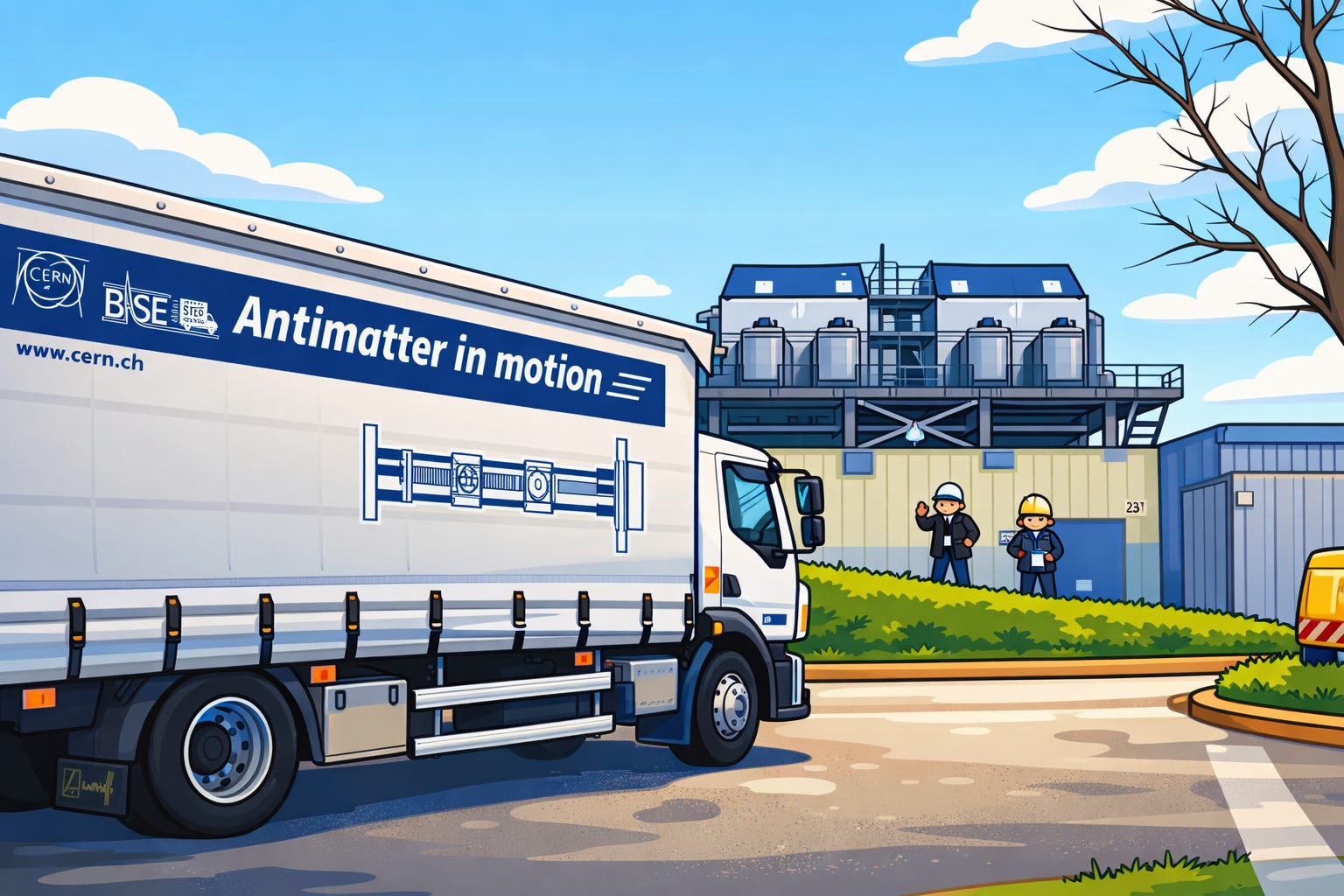
In last-week’s experiment, the antimatter just took a joy ride around CERN for 30 minutes in a van that had “antimatter in motion” cheekily painted on the side. The actual trip to Dusseldorf is eight hours and includes a border crossing. Since Switzerland isn’t in the EU, I’m very curious about how they will fill out the customs form at the German border.
Illegal Alien Anti-Particles
Once they reach Germany, the challenge will be to transfer the antiprotons to the German containers for the experiment without contacting matter and disappearing in a flash of pure energy. The journey to Düsseldorf will also require keeping the BASE-STEP at a temperature of 8.2 Kelvin (colder than Minnesota in January) for the entire trip. They are looking into generators that would be up to the task.
Solving the Mystery
According to the big bang theory (the actual theory, not the show) there should have been an equal amount of antimatter and matter created at the start of the universe. Somehow, we only got matter. The question about what happened to all the antimatter has been keeping scientists up at night ever since. I’m pretty sure that CERN is getting close to proving their hypothesis that it went to an alternate universe, probably through a black hole – in a moving van.
I wanted to know how big an explosion would result if the antimatter containment fields failed. (Why do I feel like I'm suddenly in an episode of Star Trek? ;-)
So I asked an AI (Perplexity). It said one antiproton-proton pair annihilation would result in about the same energy as several mosquito wingbeats. Darn.
In the course of the conversation, I gave it the actual number of 92 antiprotons and it told me that would be equivalent to 9 million mosquito wingbeats. And I'm like "What? It doesn't scale linearly?" and the AI is like "Yes, it scales linearly" and I'm like "Then 9 million is wrong!" and the AI is like "I'm sorry my loose analogy caused confusion" and I'm like "Loose? You're off by many orders of magnitude, you moron!" After several rounds of this it finally admitted that it was "a wild miscalculation." I felt vindicated. But also foolish for wasting time with an idiot savant.